AI and Drone Technology in Solar Maintenance: What’s Changing in the UAE
What if your solar panels are underperforming… and you don’t even know it?
What if small faults today turn into major losses tomorrow?
And how often do you really check every panel across your site?
It’s a bit unsettling. But it’s real.
Across the UAE, solar projects are expanding fast. New installations, larger capacities, tighter performance targets. Everything is scaling up. But maintenance? That is where many businesses start to feel pressure.
Dust builds up almost daily. Heat affects output. Small faults go unnoticed. Over time, efficiency drops. Quietly.
That is why solar maintenance technology in the UAE is evolving. Not slowly. Rapidly.
AI, drones, and predictive tools are no longer experimental. They are becoming part of everyday operations for companies that want consistency and control.
Let’s break this down in a simple, practical way.
Solar Maintenance in the UAE: A Tough Reality
At first glance, solar panels seem low-maintenance. Install them, connect them, and let them run.
But in the UAE, things are different. The environment creates constant challenges:
- Dust settles on panels almost every day
- Sandstorms leave layers that block sunlight
- High temperatures reduce efficiency
- Large solar farms are difficult to inspect manually
- Minor faults often go unnoticed
Even a thin layer of dust can reduce output significantly. Over time, this leads to real energy loss.
Now imagine this happening across thousands of panels. The numbers add up quickly.
Manual inspections? They help, but they are slow. And sometimes risky in extreme conditions.
So, businesses are looking for better ways.
AI is Bringing Visibility Where It Was Missing
Here’s something many operators struggle with. They don’t always know where the problem is.
Performance drops, but the cause is unclear.
This is where AI Solar Inspection changes everything.
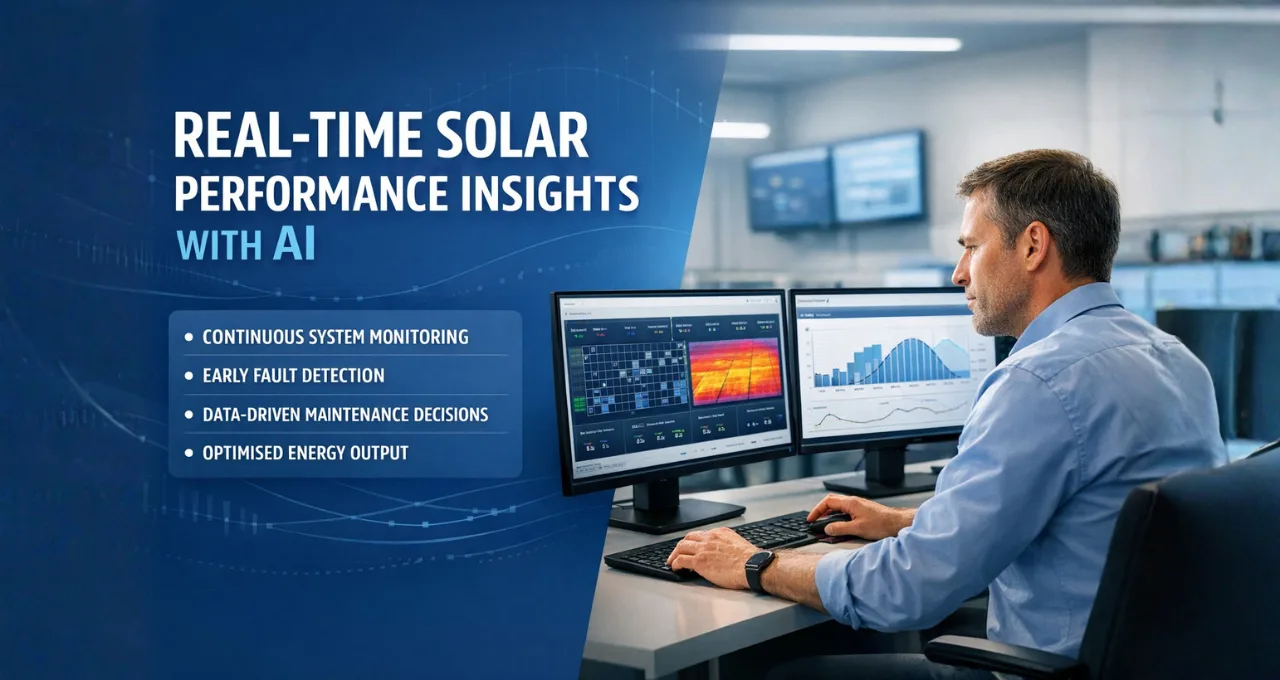
AI systems continuously monitor performance. They analyse data. They detect patterns.
And most importantly, they highlight problems early.
With AI, businesses can:
- Track performance in real time
- Detect hotspots, cracks, and faults early
- Identify underperforming panels quickly
- Predict when maintenance is needed
- Optimise output using data insights
It feels like someone is constantly watching your system. Quietly. Accurately.
No delays. No surprises.
That level of clarity changes how decisions are made.
Drones Are Redefining Solar Inspections
Now think about inspections.
Traditional methods require teams to physically check panels. It takes time. It requires manpower. And it is not always safe.
Drones offer a completely different approach.
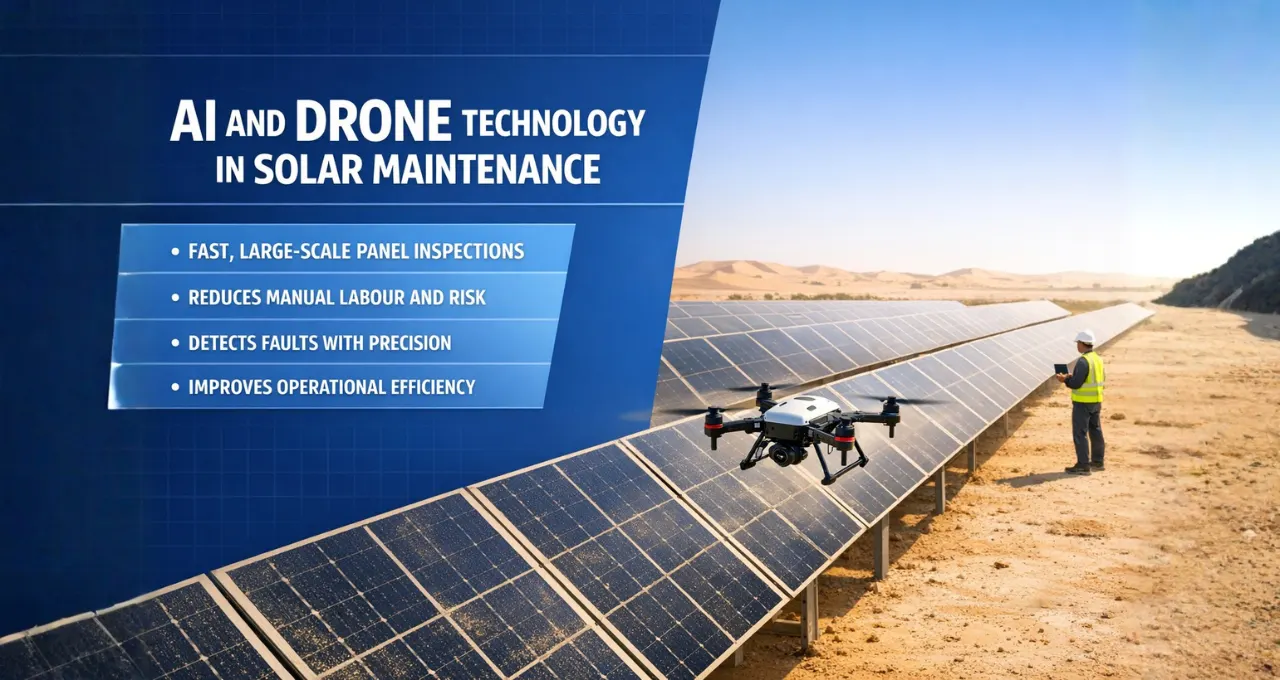
They can fly across large solar farms and scan everything in a fraction of the time.
With drones, companies can:
- Inspect large areas quickly
- Capture high-resolution images
- Use thermal imaging to detect faults
- Reduce manual labour
- Improve safety by limiting human exposure
What used to take days can now be done in hours.
That is not just efficiency. That is transformation.
And the best part? Inspections can happen without interrupting operations.
Cleaning Has Become a Strategic Priority
Let’s talk about cleaning. Often underestimated. But critical.
In the UAE, dust is the biggest enemy of solar efficiency.
Panels get dirty fast. And if they are not cleaned regularly, output drops.
Traditional cleaning methods are:
- Labour-intensive
- Time-consuming
- Dependent on water availability
- Difficult to manage at scale
This is where drone solar panel cleaning and automated systems come in.
These solutions are changing the approach completely.
They allow:
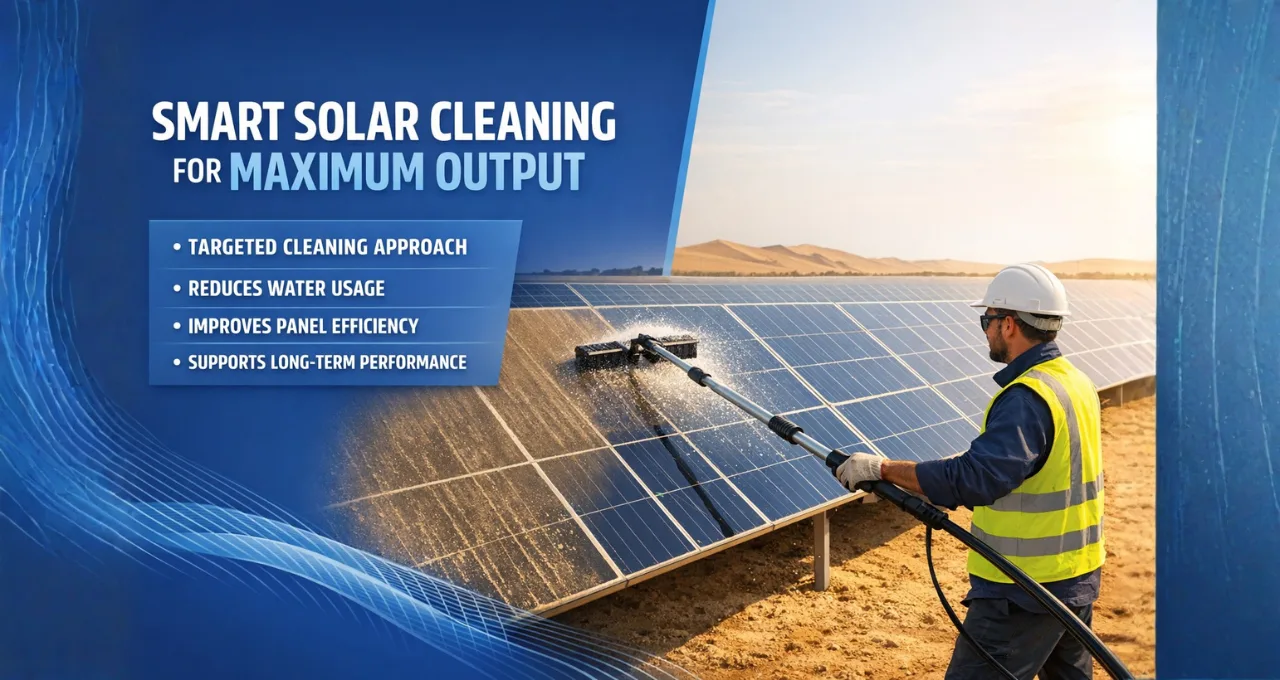
- Targeted cleaning instead of full-site cleaning
- Reduced water consumption
- Faster cleaning cycles
- Safer working conditions for teams
- Consistent maintenance schedules
It’s not just about cleaning anymore. It’s about cleaning smart.
When AI, Drones, and Predictive Tech Work Together
Individually, each technology is powerful.
But together? They create something much more effective.
A connected system.
Here’s how it works in practice:
- Drones scan the solar panels
- AI analyses the collected data instantly
- Faults and inefficiencies are identified
- Maintenance or cleaning is scheduled automatically
No waiting. No guesswork.
Just a smooth, continuous process. This kind of system allows businesses to stay ahead instead of reacting late.
What This Means for UAE Businesses
Now let’s bring it back to business impact.
For companies operating in the UAE, adopting advanced solar maintenance technology in the UAE offers clear advantages.
It helps you:
- Reduce downtime and avoid unexpected failures
- Lower long-term maintenance costs
- Improve overall energy output
- Increase safety for workers
- Manage large-scale operations more easily
In simple terms, you get more value from your solar investment.
And that matters. Especially when margins are tight.
Trends Shaping Solar Maintenance in 2026
Things are changing quickly. And the UAE is leading in many ways.
Here are key trends to watch.
- Smarter, Autonomous Drones: Drones will operate on set routes with minimal human input. Inspections will become routine and automated.
- Predictive Maintenance as Standard: AI systems will not just detect faults. They will forecast them. Maintenance will happen before problems occur.
- Data-Driven Cleaning: Panels will be cleaned based on need, not schedule. This saves water and reduces cost.
- Centralised Monitoring Platforms: All system data will be available in one place. Easy to track. Easy to manage.
- Less Manual Intervention: Automation will reduce the need for large inspection teams. Safer. More efficient.
These trends are not far away. They are already taking shape.
Challenges Businesses Should Consider
Of course, adopting new technology comes with questions.
Some common concerns include:
- Initial investment costs
- Integration with existing systems
- Need for skilled operators
- Managing large amounts of data
These are valid points. But here is something worth thinking about.
“What is the cost of staying with outdated methods?”
Lost efficiency. Higher maintenance costs. Delayed issue detection. Over time, that cost is often higher than the investment.
Frequently Asked Questions
- What is AI solar inspection in Dubai?
It uses artificial intelligence to monitor solar panels, detect faults, and predict maintenance needs in real time.
- How do drones help in solar maintenance?
Drones scan large solar farms using cameras and thermal imaging, identifying issues without manual effort.
- Is drone solar panel cleaning effective?
Yes. It targets specific panels, reduces water use, improves cleaning efficiency, and lowers labour risks.
- Is this technology suitable for large solar farms?
Absolutely. It is designed for large-scale operations and works well in harsh environments like the UAE.
Final Thoughts
Solar energy is growing rapidly across the UAE. That is clear.
But maintaining performance? That is where the real challenge lies. Dust, heat, and scale make traditional methods less effective over time.
AI, drones, and predictive systems are changing how businesses manage solar assets. They bring clarity. Speed. Control.
And perhaps most importantly, confidence.
Companies that adopt these technologies early will operate more efficiently. They will reduce risks. They will stay competitive.
Those who delay may find it harder to keep up. And in a fast-moving market, that gap matters.
Behind every strong operation, there is always a support system that keeps things running smoothly.
Euro Emirates LLC works with businesses across the UAE to support workforce operations, logistics, and on-ground execution. As projects grow in size and complexity, having the right operational support becomes just as important as the technology itself.
Because in the end, success is not just about innovation.
It is about keeping everything running… without disruption.